

tl;dr
- Traditional tools can’t keep up with DeFi, NFTs, staking, airdrops, and multi-chain wallets, leading to errors, delays, and messy audit trails.
- Legacy software lacks real-time blockchain integrations, making accurate reporting and tax prep nearly impossible in 2025.
- Web3 businesses now require automated reconciliation, multi-chain tracking, and compliant reporting to avoid misstatements and regulatory issues.
- To evaluate the best platforms, we looked at multi-chain coverage, automation depth, compliance strength, ERP integrations, pricing clarity, and verified 2025 user reviews.
Why Traditional Accounting Software Fails Web3 Businesses
Web3 businesses face a financial landscape that traditional accounting software wasn’t built to handle. DeFi protocols, NFTs, staking rewards, multi-chain wallets, airdrops, and fluctuating gas fees create complex, high-volume transactions that Excel sheets and manual CSV imports can’t reliably track. These tools lack real-time integration with blockchain data, often producing errors, delayed reporting, and gaps in audit trails.
In 2025, relying on legacy software for audits and taxes is no longer viable. Web3 businesses need accounting solutions that can automatically reconcile on-chain activity, handle tokenized assets, track multi-chain balances, and generate compliant reports.
Without these, companies risk compliance issues, financial misstatements, and missed opportunities.
How We Evaluated the Best Web3 Accounting Platforms
To identify the leading Web3 accounting platforms, we applied a thorough evaluation process designed to reflect both expertise and trustworthiness.
Key factors included multi-chain support, ensuring accurate tracking across EVM, non-EVM, and Layer‑2 networks. We examined automation depth, evaluating how well platforms handle bookkeeping, staking rewards, airdrops, and on-chain data without manual intervention. Compliance and audit readiness were critical, including robust audit trails, tax reporting capabilities, and regulatory alignment. We also considered ERP integrations for businesses using existing financial systems, along with pricing transparency, avoiding platforms with hidden fees or confusing tiers.
Finally, we incorporated real user reviews from 2025, giving insight into performance, reliability, and customer satisfaction across DeFi protocols, NFT marketplaces, DAOs, and more.
Top 5 Best Web3 Accounting Software in 2025 (Ranked)
1 TRES Finance – Best Overall for Regulated Crypto Firms & DAOs
TRES Finance stands out as a leading crypto accounting and treasury management platform for complex Web3 businesses, funds, OTC desks, and multi-entity organizations. In 2025, it supports over 200 blockchains, major exchanges like Coinbase and Binance, and integrates seamlessly with thousands of global banks and traditional ERP systems such as NetSuite, QuickBooks, and Xero, delivering unified crypto and fiat financial data in one platform.
Its standout features include real-time compliance monitoring, automated audit trails, and institutional-grade reporting compliant with GAAP and IFRS standards. AI-powered automation handles transaction tagging, gain/loss calculations, real-time reconciliation, valuation at precise timestamps, and multi-currency conversions, dramatically reducing manual accounting work.
For treasury management, TRES Finance aggregates crypto holdings alongside traditional assets, helping CFOs and treasurers make smarter liquidity and portfolio decisions. Advanced modules track staking rewards, validator commissions, and offer anomaly detection and analytics on asset performance. With audit readiness, regulatory compliance, and integration ease at its core, TRES Finance is the ideal solution for regulated crypto firms, DAOs, and enterprises navigating the increasingly complex Web3 financial landscape.
2 Cryptio – Best for Enterprise-Grade Compliance & ERP Integration
Cryptio is a leading crypto accounting platform designed for medium-to-large Web3 companies, asset managers, and public enterprises holding crypto, with a focus on institutional-grade compliance and audit-ready financial reporting. In 2025, it supports deep integrations with major ERP systems such as NetSuite, Sage, and Xero, while providing full IFRS and GAAP compliance, automated cost basis tracking, and ongoing tax position oversight.
The platform emphasizes strong internal controls, transaction validation, and maintains up-to-date SOC 1 and SOC 2 certifications, ensuring high-quality, reliable financial data. Its broad connectivity spans major blockchains, exchanges, and custodians, offering comprehensive APIs that enable seamless crypto-to-fiat accounting alongside existing enterprise systems.
While Cryptio excels at traditional financial reporting and regulated compliance, it offers more limited support for complex on-chain DeFi protocols compared to DeFi-native platforms, making it best suited for enterprises with moderate DeFi exposure.
With its combination of audit-ready reporting, ERP integration, and SOC-certified controls, Cryptio empowers institutional teams to manage crypto assets confidently, maintain regulatory compliance, and streamline financial governance across both traditional and blockchain-based assets. It remains a top choice for organizations prioritizing accuracy, transparency, and enterprise-grade control in 2025.
3 Bitwave – Best for High-Volume DeFi & On-Chain Operations
Bitwave is a leading digital asset finance platform tailored for enterprises managing cryptocurrency, stablecoins, and complex DeFi positions. In 2025, it excels at handling high-volume DeFi operations, such as lending, liquidity provider positions, yield farming, and NFT transactions.
The platform supports multi-chain accounting across 80+ blockchains and DeFi protocols, offering automated transaction reconciliation, real-time valuation, cost-basis tracking, and on-chain invoice processing. Enterprise teams can choose customizable accounting methods such as FIFO, HIFO, or average cost, ensuring compliance with internal policies and regulatory standards.
Bitwave integrates natively with major ERP and accounting platforms, including Oracle NetSuite, SAP, QuickBooks, Sage Intacct, and Xero, enabling the flow of blockchain data into general ledgers. Its enterprise-grade security includes SOC 1 and SOC 2 compliance, vendor wallet verification, audit logs, and a strategic Deloitte partnership to enhance audit readiness.
Additional features include NFT accounting with direct marketplace integrations and customizable APIs for tailored enterprise workflows. Trusted by public companies, fintech startups, and large-scale crypto operations, Bitwave unifies DeFi, NFT, and crypto accounting with real-time automation, compliance, and comprehensive financial oversight.
4 Lukka – Best for Institutional Investors & Accounting Firms
Lukka is a premier enterprise-grade crypto data and financial software provider, trusted by Big-4 audit firms, hedge funds, and institutional investors. In 2025, it specializes in aggregating, normalizing, and delivering real-time and historical on-chain data across 100+ blockchains, offering dependable blockchain intelligence for financial institutions, auditors, asset managers, and enterprises.
The platform provides comprehensive pricing data covering over 10,000 trading pairs and 27 exchanges, enabling GAAP- and IFRS-compliant fair market value (FMV) calculations. Lukka’s proprietary FMV methodology minimizes price manipulation risk using transparent, executed-price-based valuations, widely adopted by top audit firms and major institutions such as State Street and eToro.
Unlike full-service accounting platforms, Lukka does not handle transaction categorization, reconciliation, or regulatory reporting. Instead, it delivers raw blockchain data feeds and actionable blockchain intelligence, which can be integrated into in-house accounting systems, analytics tools, or trading platforms. This makes it ideal for organizations seeking high-quality crypto financial data while retaining control over accounting workflows.
5 Cryptoworth – Best for Fast-Growing Web3 Startups & SMEs
Cryptoworth has emerged as one of the strongest crypto accounting platforms for rapidly scaling Web3 startups and SMEs in 2025. Its speed and ease of use surprise most teams when they first try it. The platform offers lightning-fast onboarding, smooth data ingestion, and some of the best QuickBooks and Xero sync capabilities in the industry. Its 2025 free tier is also one of the most generous, making it ideal for early-stage teams that need enterprise-level tooling without enterprise-level cost.
Supporting 190+ blockchains, 80+ exchanges, and a broad range of wallets and custodians, Cryptoworth automates everything from transaction classification to gain/loss calculations and multi-method cost basis tracking. It handles DeFi, NFTs, staking rewards, and even SAFT management with remarkable accuracy.
For finance teams, the platform shines with its audit-ready trails, GAAP/IFRS-aligned reporting, multi-entity controls, and real-time portfolio visibility across complex, multi-chain operations. Add in two-way ERP syncing, and you get a streamlined, compliance-focused system built for serious growth.
Honorable Mentions & Specialized Tools
While not full-stack platforms, several specialized solutions deserve recognition for serving niche but important areas of Web3 finance in 2025. Camuso CPA remains the top choice for businesses that want a fully done-for-you Web3 tax and accounting service, offering white-glove support, bespoke reporting, and hands-on guidance for complex portfolios. Node40 continues to lead in Proof-of-Stake accounting, providing some of the most accurate staking, delegation, and reward-based tax reporting available today.
For enterprises with intricate treasury needs, Breezing.io stands out as a powerful crypto subledger, enabling granular transaction mapping, multi-entity support, and advanced reconciliation workflows. Meanwhile, Verady Ledgible remains a reliable go-to option for smaller operations and individuals, offering straightforward integrations and clean reporting for simpler portfolios.
Feature Comparison Table (2025 Edition)
.webp)
Which Web3 Accounting Software Is Right for You?
Choosing the right Web3 accounting platform in 2025 comes down to the type of organization you’re running and how complex your on-chain activity is. Crypto funds and high-frequency trading firms typically lean toward TRES or Cryptio, both built for data precision, auditability, and handling massive transaction throughput without slowing down.
If you’re a DeFi-native protocol or a treasury managing high-volume multi-chain flows, Bitwave is often the best fit thanks to its powerful automations, deep DeFi support, and scalable accounting workflows tailored for operational teams.
For public companies and large enterprises, Cryptio and Lukka stand out with their robust compliance frameworks, enterprise integrations, and GAAP/IFRS-aligned reporting, qualities needed for auditors and regulators.
Fast-growing startups and SMEs usually find the right mix of simplicity, automation, and affordability with Cryptoworth, which offers smooth Xero/QuickBooks syncing and strong multi-chain coverage.
And if you need a done-for-you solution combining CPA expertise with software, Camuso CPA delivers hands-on support for everything from tax filings to complex reporting.
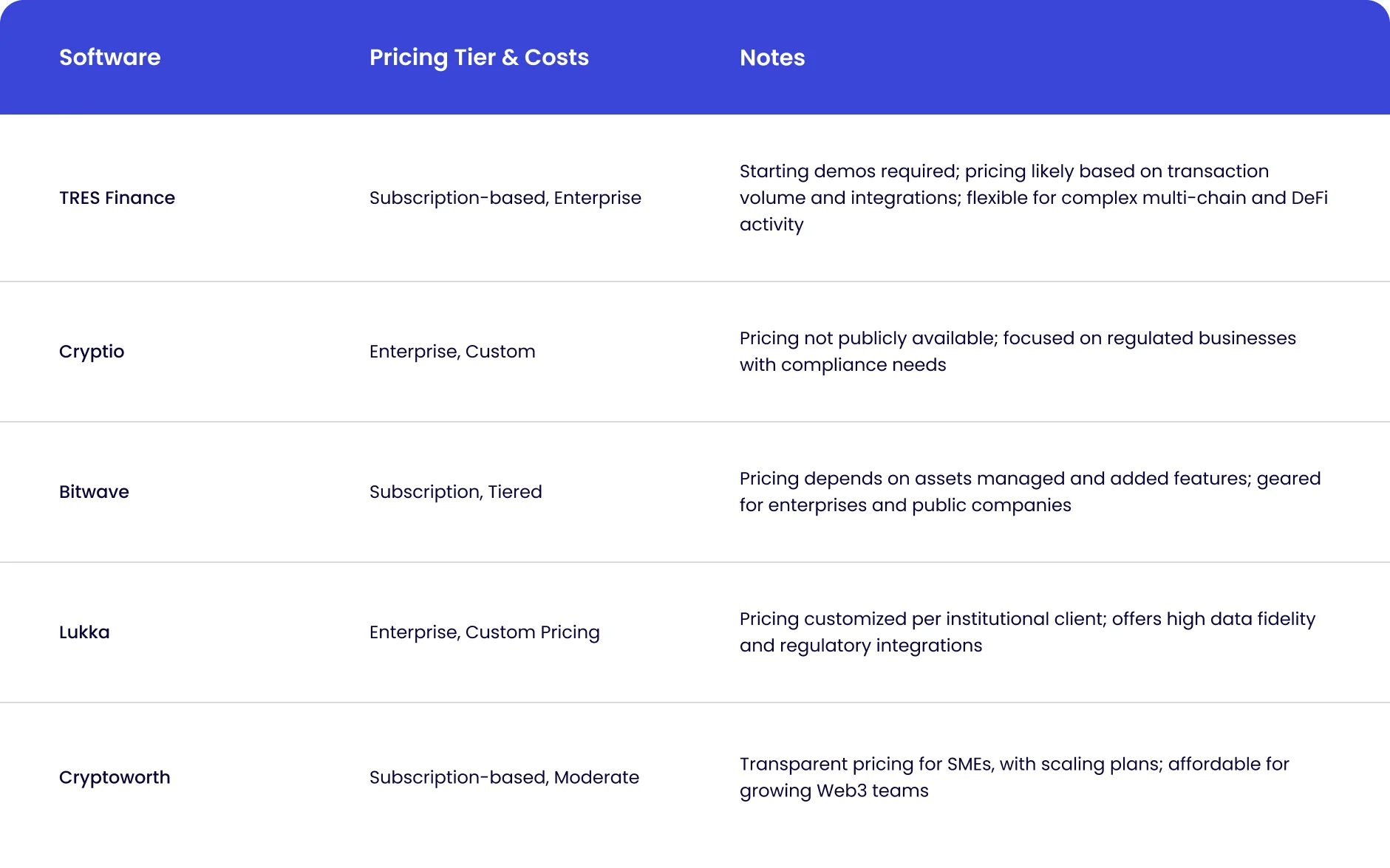
How Much Does Web3 Accounting Software Cost?
Key Features Every Web3 Accounting Tool Must Have in 2025
As digital asset activity becomes more complex and regulators tighten expectations, Web3 accounting platforms in 2025 must meet a far higher standard than in previous years. The foundation starts with automated cost-basis tracking, including FIFO, LIFO, and HIFO. That way, finance teams can maintain accurate tax positions across thousands of transactions without manual intervention.
A modern platform must also deliver full DeFi and NFT transaction decoding, translating swaps, liquidity positions, staking rewards, NFT mints, bridges, and protocol-specific actions into clean, auditable accounting entries. This goes hand-in-hand with real-time tax-lot relief calculations, ensuring gains, losses, and disposals are always up to date for financial reporting and tax planning.
For audits, the baseline is now comprehensive, audit-ready export packages that include audit trails, valuation methods, cost-basis history, wallet-level reconciliation, and immutable transaction logs.
Finally, as more Web3 companies operate globally and across multiple business units, multi-entity and sub-ledger support has become essential.